
BVO NIR Polarizers
All new, purely absorptive broadband NIR linear polarizers. There are no wire grid films in any of these NIR products and often have increased contrast ratios. NIR Ultra is intended for max performance required by demanding biometric imaging applications. NIR HD (high durability) is ideal for applications with damage threshold or environmental tolerance requirements. NIR HD also has a larger format size option for illumination panels. NIR DS2 offers the highest contrast ratio in the NIR bandwidth. Polarized near infrared light makes previously invisible defects identifiable.
BVO NIR ULTRA –
BROADBAND LINEAR POLARIZER

- Very high contrast ratios
- Replace wire grid polarizer
- Active Range: 400nm – 1000nm
- Hybrid Visible / NIR polarizer
- Type – transmissive, absorptive
- A4 sheet format
- Imaging capable
Applications
- Vein Viewing Polarizer
- Fundus Camera Polarizer
- NIR Sensors – Optical, Solid State
- Retroreflective Sensor Polarizer
- LIDAR – Range Finding
- Biometrics Polarization
- Broadband Machine Vision Glare Reduction

contrast ratio
400nm = 3,930:1
contrast ratio
450nm = 13,000:1
contrast ratio
500nm = 21,213:1
contrast ratio
550nm = 21,299:1
contrast ratio
600nm = 20,559:1
contrast ratio
650nm = 20,524:1
contrast ratio
700nm = 22,724:1
contrast ratio
750nm = 9,493:1
contrast ratio
800nm = 3,424:1
contrast ratio
850nm = 5,368:1
contrast ratio
900nm = 8,661:1
contrast ratio
950nm = 7,715:1
contrast ratio
1000nm = 2,364:1
Downloads


retinal health – biometrics

Retinal Imaging Using Fundus Cameras
BVO NIR Polarizers increase the contrast for imaging veinous pattern and tissue health in the retina. BVO NIR broadband polarizers also work in visible light allowing for imaging throughout the 400-1000nm bandwidth.
Key advantages by using BVO NIR polarizers
- Lower cost than competing high contrast glass polarizers
- Custom piece sizes, high resolution .dxf patterns
- Absorptive polarizer, no back reflections in optical system
BVO NIR HD – High Durability
BROADBAND LINEAR POLARIZER
- High contrast ratios
- Resists LED “burn in”
- Active Range: 400nm – 1000nm
- Hybrid Visible / NIR polarizer
- Type – transmissive, absorptive
- Large sheet format – in development
- High durability for illumination systems
- Optical systems in high humidity
Applications
- Polarizer for High Intensity LEDs – No Burn
- Fruit Inspection Illumination Lighting
- NIR Sensors – Optical, Solid State
- Automotive Applications
- License Plate Recognition
- Plastics Sorting, Recycling Identification
- Semiconductor & PCB Inspection

contrast ratio
400nm = 1,718:1
contrast ratio
450nm = 12,497:1
contrast ratio
500nm = 15,267:1
contrast ratio
550nm = 23,796:1
contrast ratio
600nm = 33,006:1
contrast ratio
650nm = 34,094:1
contrast ratio
700nm = 8,187:1
contrast ratio
750nm = 1,976:1
contrast ratio
800nm = 1,356:1
contrast ratio
850nm = 4,379:1
contrast ratio
900nm = 9,118:1
contrast ratio
950nm = 7,838:1
contrast ratio
1000nm = 2,386:1
Downloads
Food inspection – Multispectral quality control

Using machine vision for fruit inspection sorting and meat quality control
BVO NIR Polarizers eliminate glare in high speed machine vision sorting systems. NIR broadband polarizers are designed to meet optical system specifications requiring higher damage thresholds (from LEDs) and challenging environmental conditions.
Key advantages by using BVO NIR polarizers
- High durability polarizers to combat LCD “burn”
- Larger panel sizes for custom illumination components
- Increased NIR extinction helps identify target defects
- Matching camera polarizer with custom sizes

BVO NIR DS2 – High Durability
BROADBAND LINEAR POLARIZER
- Highest contrast ratio available
- Resists LED “burn in”
- Active Range: 550nm – 1100nm
- Broadband NIR polarizer
- Type – transmissive, absorptive
- A4 sheet format
Applications
- Ultra Contrast Machine Vision Polarizer
- LED Illumination Lighting
- High Contrast NIR Cameras & Sensors
- Automotive Applications
- Plastics Sorting, Recycling Identification
- Optical Systems in Demanding Environmental Conditions

contrast ratio
400nm = 6:1
contrast ratio
450nm = 23:1
contrast ratio
500nm = 177:1
contrast ratio
550nm = 1,743:1
contrast ratio
600nm = 11,702:1
contrast ratio
650nm = 27,686:1
contrast ratio
700nm = 27,543:1
contrast ratio
750nm = 20,062:1
contrast ratio
800nm = 35,019:1
contrast ratio
850nm = 38,042:1
contrast ratio
900nm = 45,693:1
contrast ratio
950nm = 36,461:1
contrast ratio
1000nm = 30,000:1
contrast ratio
1050nm = 20,784:1
contrast ratio
1100nm = 434:1
Downloads
Recycling – High accuracy machine vision

sorting identification for plastics recycling
BVO NIR Polarizers offer high extinction ratios for modern LED visible and near infrared sources. Rapid evaluation of plastic species using NIR imaging systems requires precision results in order to properly reimburse customers.
Key advantages by using BVO NIR polarizers
- No internal back reflections causing stray light
- Maximum contrast for machine vision systems
- NIR DS2 has > 30,000:1 extinction, 830nm-950nm
- NIR achromatic optical isolators (700-1000nm) available
NIR Ultra Film Specs
| Polarizer Range | 400nm-1000nm |
| Contrast Ratio Visible | 20,000:1, nominal |
| Contrast Ratio NIR | 7,000:1, nominal |
| Maximum Dimension | A4, 297mm x 210mm |
| Thickness | .345mm |
| Film Cutting Tolerances | ± 50 microns |
| Adhesive (PSA) | None , PSA conversion option |
| Temperature Range | -20° C to 70° C |
| Damage Threshold | 1 W/cm2, CW 0.2 J/cm2 with 20 nsec pulse, visible |
| Color | Neutral Gray |
| Substrate | Plastic Type, “Cellulose Triacetate”, dichroic |
| Surface Quality | 80/50 Scratch-Dig |
NIR HD Film Specs
| Polarizer Range | 400nm-1000nm |
| Contrast Ratio Visible | 20,000:1, nominal |
| Contrast Ratio NIR | 5,000:1, nominal |
| Maximum Dimension | > A4, in development |
| Thickness | .423mm |
| Film Cutting Tolerances | ± 50 microns |
| Adhesive (PSA) | None , PSA conversion option |
| Temperature Range | -20° C to 95° C |
| Damage Threshold | 1 W/cm2, CW 0.2 J/cm2 with 20 nsec pulse, visible |
| Color | Neutral Gray |
| Substrate | Plastic Type, “Cellulose Triacetate”, dichroic |
| Surface Quality | 80/50 Scratch-Dig |
NIR DS 2 Film Specs
| Polarizer Range | 550nm-1065nm |
| Contrast Ratio | 28,000:1, VIS/NIR nominal |
| Maximum Dimension | A4, 297mm x 210mm |
| Thickness | .390mm |
| Film Cutting Tolerances | ± 50 microns |
| Adhesive (PSA) | None , PSA conversion option |
| Temperature Range | -20° C to 90° C |
| Damage Threshold | 1 W/cm2, CW 0.2 J/cm2 with 20 nsec pulse, visible |
| Color | Neutral Gray |
| Substrate | Plastic Type, “Cellulose Triacetate”, dichroic |
| Surface Quality | 80/50 Scratch-Dig |
Optional Lamination Substrates :
Optical Grade BK-7
Low Wavefront Distortion Glass
- Industry standard optics glass
- Good transmission visible and NIR
- Best for low wavefront distortion
- Thickness flexibility
- Double side polished, lambda/10 flatness
- Refractive index – 1.52

BK-7 Glass Transmission Chart

Bk-7 Optional NIR BBAR COATING
- R ≤ .65% per surface, avg.
- Ultra broad range, 400nm to 950nm
400-950nm BBAR on BK-7 scan – typical

Corning Display Glass
Results in thin final components
- Thin glass, excellent clarity
- No residual birefringence
- Imaging quality flatness
- No added heavy metals
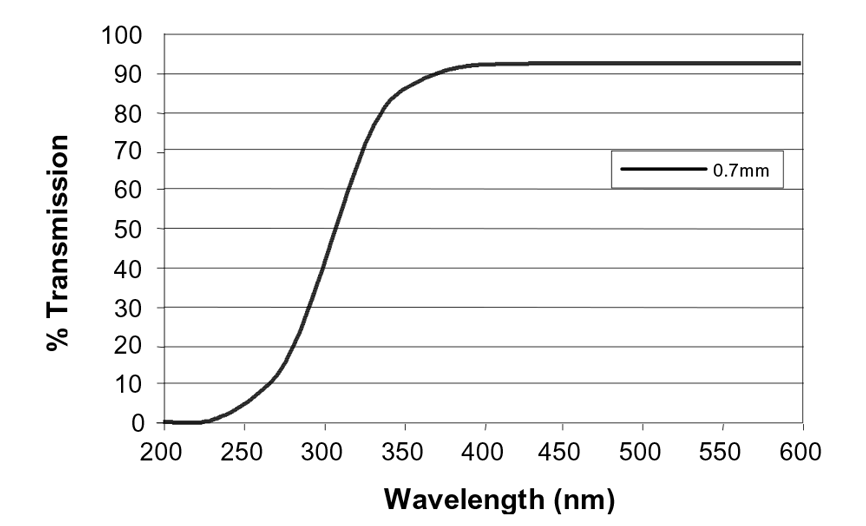
- 0.5, 0.7mm, 1.1mm options for thickness
- Refractive index – 1.50
Corning Glass Transmission Chart
Eagle XG Optional NIR BBAR COATING
- R ≤ .65% per surface, avg.
- Ultra broad range, 400nm to 950nm
400-950nm BBAR on Eagle XG scan – typical

Non-Birefringent Acrylic
Inexpensive Complex Shapes
- No residual birefringence substrate
- Cheapest option for laminated products
- Digitally cut for all geometric shapes
- Thin flexible substrate (bends)
- 0.2mm – 5.0mm options for thickness
- Refractive index – 1.49
Non-birefringent acrylic transmission chart
